
Most conversations about board exam preparation start in Class 9. Parents look for coaching, revision plans, and NCERT strategies once the exam is two years away. By then, a lot of the outcome has already been decided.
The stronger predictor of how a child handles Class 10 and Class 12 board exams isn't the revision plan they follow at 15. It's the reading fluency, number sense, and study habits they built between ages 6 and 10, long before "board exam" is even part of their vocabulary.
Does board exam performance really depend on the primary years?
Yes. Large-scale research on early academic skills shows that reading and math ability at school entry are among the strongest predictors of achievement all the way through high school, even after accounting for family background. In practice, this means the habits and concept clarity built in primary school carry forward directly into how a student performs under board exam conditions years later.
That's not a motivational claim. It's what shows up consistently when researchers track the same children from kindergarten through their final school years.
What the research actually shows
A widely cited analysis of early academic predictors found that school-entry math skills carry the strongest link to later achievement, followed closely by reading skills, with attention-related skills trailing behind both. Specifically, a child's ability to read numerals, count with understanding, recognise patterns, and compare quantities at age five or six predicted their reading and math scores well into elementary school and beyond.
The same body of research found something else worth sitting with: early socio-emotional behaviour, on its own, was a weak predictor of later academic performance. What mattered was concept clarity in the early years, not just classroom behaviour or early "giftedness."
Translate that into a CBSE context. A child who genuinely understands place value in Class 2, rather than memorising the steps to get the right answer, is building the exact conceptual muscle that Class 10 board exams now test directly through case-based and application questions.
India's foundational learning gap, in numbers
The 2024 Annual Status of Education Report (ASER) found that only 23.4% of Class 3 children in government schools could read a Class 2-level text, though this was an improvement from 16.3% in 2022. By Class 5, 44.8% of students could read at Class 2 level, still short of full grade-level proficiency for a large share of children nationally.
Arithmetic tells a similar story. The share of Class 3 students able to solve a basic subtraction problem rose from 25.9% to 33.7% between 2022 and 2024, and Class 5 students able to solve division problems rose from 25.6% to 30.7% over the same period.
These numbers matter beyond the primary classroom. A child who reaches Class 6 without solid reading fluency or number sense isn't just behind in that year's syllabus. They're carrying a gap forward into every subject that depends on reading comprehension and mathematical reasoning, including the board exam years.
How NEP 2020 already connects the dots
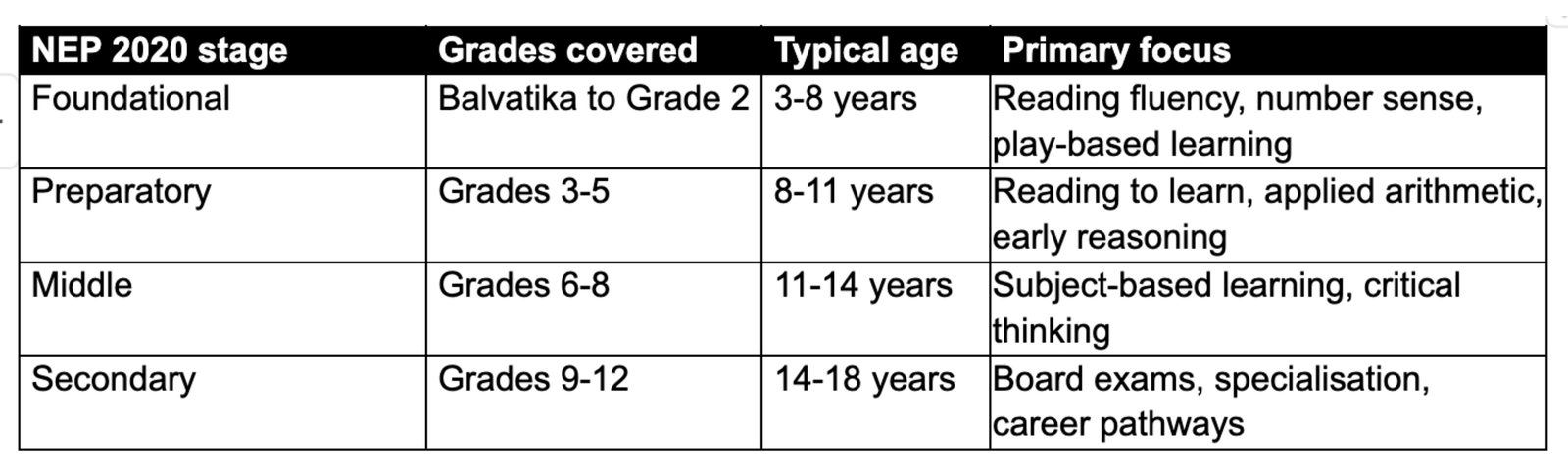
This isn't a new observation. NEP 2020 states plainly that without foundational literacy and numeracy, the rest of the policy's ambitions become largely irrelevant. That's why the policy restructured schooling into a 5+3+3+4 model, with the first stage, the Foundational Stage, covering ages 3 to 8, deliberately isolated as the period where reading, number sense, and learning habits get built before anything else is layered on top.
The government's NIPUN Bharat mission followed directly from this, setting a national target for every child to achieve foundational literacy and numeracy by the end of Grade 3, with Grade 2 proficiency as an interim milestone.
CBSE's rollout of the Holistic Progress Card reinforces the same idea from the assessment side. Instead of measuring only rote recall, it tracks a child's cognitive, socio-emotional, and competency-based development from the Foundational Stage onward, precisely because CBSE's own board exam pattern has shifted toward case studies, assertion-reason questions, and applied problem-solving that reward conceptual depth over memorisation.
What board exam readiness actually looks like at age seven
None of this means introducing exam pressure to a seven-year-old. It means building five specific habits well before they're needed for any exam.
● Reading fluency, not just reading aloud. A child who reads a passage and can explain what it meant is building the comprehension skill that every board exam subject, including maths and science, depends on for reading and interpreting questions correctly.
● Number sense over memorised procedures. Understanding why regrouping works in subtraction matters more at this stage than speed. Procedural shortcuts without understanding tend to break down the moment a question is phrased differently, which is exactly how modern CBSE papers are designed.
● Concept-first learning across subjects. Encouraging "why" and "how" questions at home, not just "what's the answer," builds the reasoning habit that application-based board questions are built to test.
● Consistent, low-stakes assessment feedback. Regular, specific feedback (through tools like the Holistic Progress Card) helps a child build self-awareness about their own learning gaps early, when they're small and easy to close.
● A steady routine around independent work. Ten focused minutes of independent reading or problem-solving at age eight builds the self-directed study habit that a Class 10 student will need to sustain for hours a day, without it ever feeling like a sudden new demand.
Common mistakes parents make in the primary years
● Treating Classes 1 to 5 as low-stakes. Report cards in these years often look reassuring even when foundational gaps exist, since assessment at this stage rarely tests deep comprehension the way board exams eventually will.
● Prioritising speed and marks over understanding. A child who gets the right answer quickly but can't explain the reasoning is building a gap that surfaces later, usually around Class 9 or 10.
● Waiting for a "wake-up call" in Class 8 or 9. By then, some conceptual gaps from Class 3 or 4 have compounded across several years of subjects built on top of them.
● Outsourcing reading entirely to school. Twenty minutes of reading at home most days does more for long-term comprehension than an additional worksheet.
● Assuming coaching can fix everything by Class 10. Coaching can sharpen exam technique, but it can't retroactively build number sense or reading fluency that should have developed years earlier.
Frequently asked questions
1. Does what happens in primary school really affect Class 10 board exam results?
Yes. Longitudinal research on early academic skills shows that reading and math ability at school entry are among the strongest predictors of achievement through high school, largely because later subjects and exam formats build directly on early conceptual foundations.
2. What is the NEP 2020 Foundational Stage?
The Foundational Stage is the first stage in NEP 2020's 5+3+3+4 structure, covering ages 3 to 8 (Balvatika through Grade 2), with a deliberate focus on reading fluency, number sense, and play-based learning before formal subject teaching begins.
3. What is NIPUN Bharat?
NIPUN Bharat is the Government of India's mission, launched under NEP 2020, to ensure every child achieves foundational literacy and numeracy by the end of Grade 3, with an interim target of Grade 2-level proficiency.
4. Is India's foundational learning gap actually a serious problem?
Government and independent data both point to real gaps. ASER 2024 found only 23.4% of Class 3 children in government schools could read a Class 2-level text, though this reflects meaningful improvement from 16.3% in 2022.
5. What is the CBSE Holistic Progress Card?
The Holistic Progress Card is a competency-based assessment tool CBSE has rolled out from the Foundational Stage onward, tracking a child's cognitive, socio-emotional, and skill-based development rather than relying only on marks from traditional tests.
6. What can parents actually do at home in the primary years?
Consistent daily reading, encouraging "why" and "how" questions instead of just checking answers, and treating small conceptual gaps seriously as soon as they appear are the most reliable, low-effort habits that support long-term academic readiness.
Conclusion
Board exam readiness was never really about Class 10. It's the compounding result of whether a child built genuine reading comprehension and number sense years earlier, in classrooms that treated the primary years as foundational rather than as a formality before the "real" schooling begins.
At GVK Vidhya Mandir, our primary years curriculum is built around exactly this idea, prioritising concept clarity and reading fluency early, so that the board exam years become a continuation of strong habits rather than a scramble to build them.